The Rise of the Superworker: What World Future Day in Oslo Revealed About the Future of Work
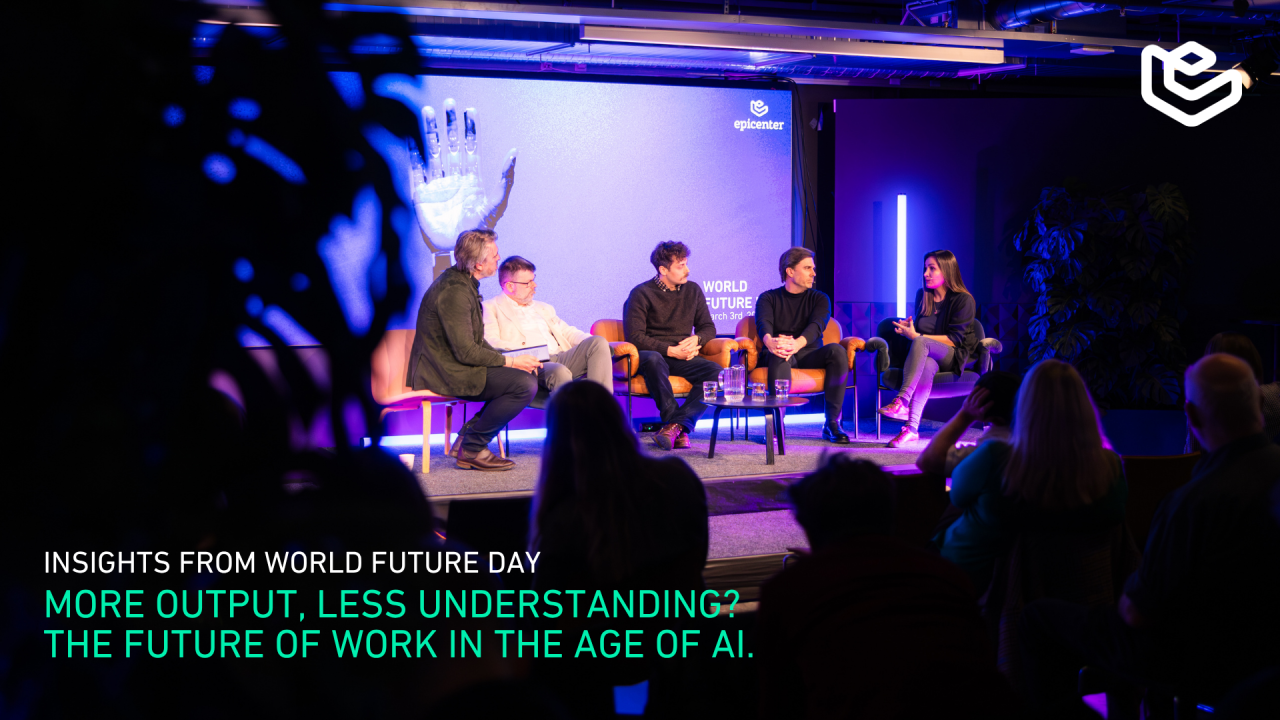
Earlier this month, Epicenter Oslo gathered innovators, researchers, and leaders to celebrate World Future Day. Moderated by futurist Eirik Norman Hansen, the conversation brought together Imac Zambrana, PhD (TECHEP), Adrian McDonald (Epicenter Group), Vojtěch Haničinec (Oslo University Hospital), and Jan Dyre Bjerknes, PhD (swarm robotics researcher and philosopher). Together they mapped out how AI, human skills, and new organizational models may shape the next era of work.
The rise of the Superworker
Adrian McDonald, CEO at Epicenter, described how professionals are entering an acceleration phase — what he calls the rise of the Superworker. Someone who combines strong expertise with AI tools to significantly increase their output and efficiency. Capable of producing what traditional teams once required to deliver.
Good workers will become great. Great workers will become exceptional.
But that shift raises an important question for organisations today. If technology multiplies individual productivity, what happens to skills, learning, and the structure of work itself?
Productivity without understanding
Jan Dyre Bjerknes, PhD pointed to trends already visible in education. The distribution of performance is changing. Some students are becoming exceptionally strong. Others are struggling to keep up. Students can produce impressive papers, presentations, and analyses using generative tools, but when asked to explain their thinking, many can't articulate the reasoning behind their output.
Imac Zambrana, PhD put a name to it: cognitive offloading. We appear smarter on the surface while actual understanding quietly erodes.
If organisations and education systems fail to adapt how we learn and evaluate knowledge, we risk optimising for appearance instead of competence. That's a dangerous direction for the future workforce.
A structural shift in how we work
The conversation also pointed toward deeper structural changes. Work may become more fluid, with teams forming around problems rather than departments. AI agents handling entire workflows while humans focus on purpose, direction, and decision-making.
And as all of this accelerates, something unexpected is becoming the most valuable quality in the room.
The most valuable person in the future may not be the most efficient one. It may be the person who knows when to slow things down.
Human skills will become more valuable, not less
Across the discussion, the panel kept returning to the same point: critical thinking, collaboration, curiosity, ethical judgment, domain expertise. These don't become obsolete as AI scales — they become the differentiator.
Human judgment remains essential, especially as systems grow more autonomous.
Build for learning. Or fall behind.
Reskilling cycles may occur every few years rather than once or twice in a career. For organisations, that's a new kind of leadership challenge. The future workplace must be designed around learning, adaptability, and knowledge transfer.
The organisations that succeed will be those that use technology to amplify human capability, not replace it. If people stop learning, if organisations resist change, and if education systems fail to adapt, the gap between those who thrive and those who struggle will widen fast.
FAQ
Q: What is a Superworker?
A: A term coined by Adrian McDonald, CEO at Epicenter, to describe professionals who combine deep expertise with AI tools to dramatically increase their output, producing what traditional teams once required to deliver.
Q: What is cognitive offloading and why does it matter?
A: Cognitive offloading is when people delegate thinking to tools without retaining the underlying understanding. As raised by Imac Zambrana, PhD, it means we can appear more capable on the surface while actual comprehension declines, a risk for both education and the workforce.
Q: How is AI changing the structure of organisations?
A: The panel pointed to a shift toward more fluid, problem-centred teams, where AI agents handle workflows and humans focus on purpose and direction. This requires organisations to actively build for learning and adaptability.
Q: What human skills will matter most in the future?
A: Critical thinking, curiosity, collaboration, ethical judgment, and domain expertise, all flagged by the panel as becoming more valuable, not less, as AI becomes more autonomous.
Q: What should organisations do to prepare?
A: Design environments where continuous learning is built in, reskilling happens regularly, and technology amplifies human capability rather than substituting it.